

















































What’s Behind the Fluctuating Cost of Eggs
Egg prices have become one of the clearest indicators of inflation and food costs in the United States. After several months of record highs, driven by avian flu outbreaks, increased feed costs, and supply chain disruptions, the national average price for a dozen Grade A eggs fell to $2.52 in June 2025, according to USDA data. This was more than 60% lower than the peak of $6.22 in March, which was the highest price in recent history..
These swings are driven by several key factors:
- Avian influenza outbreaks: A highly pathogenic bird flu (HPAI) strain has decimated egg-laying hen flocks across major production states.
- Centralized supply chains and facility losses: Large-scale egg production in the U.S. (often involving hundreds of thousands of hens per site) means that disease outbreaks or disruptions impact supply more significantly than in more decentralized systems.
- Rising production costs & regulation: Higher feed costs, energy costs, and infrastructural investments for cage-free or enhanced welfare standards in some states (e.g., California, Colorado) add to base prices.
- Import intervention and inventory shifts: The federal government responded to supply shortages by expanding imports (e.g., eggs from Turkey and Brazil) and declared that wholesale egg prices had fallen by 64% and retail prices by 27% after the peak shortages.
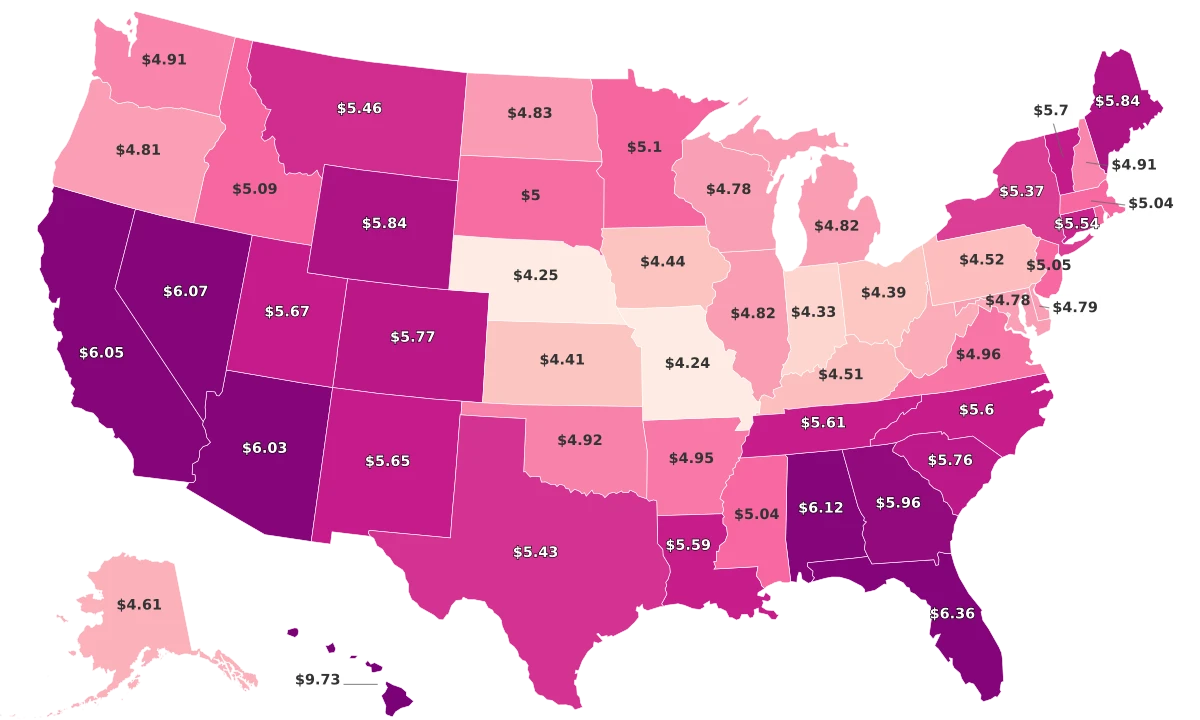
Even as the U.S. average has fallen, the cost of eggs continues to vary sharply by state. In 2025, prices range from about $4.24 in Missouri to $9.73 in Hawaii, reflecting the combined influence of tax policies, transportation costs, and ongoing recovery from the avian flu supply shock.
Key Findings
- According to the United States Department of Agriculture (USDA), the average national egg price in June 2025 is $2.52 per dozen, down from a historic peak of $6.22 in March.
- Hawaii has the highest state-level egg price at $9.73 per dozen, nearly four times the national average.
- Florida ($6.36), Nevada ($6.07), and California ($6.05) follow, all states with higher transport costs or strict cage-free laws.
- Iowa experienced the steepest inflation at +153%, while Washington (+15%) saw the lowest, showing major regional differences.
States with the Highest Egg Prices
Hawaii has the most expensive eggs in the country, averaging $9.73 per dozen, nearly four times the national average. Florida ranks 2nd at $6.36, followed by Alabama ($6.12), Nevada ($6.07), and California ($6.05). Arizona ranks 6th at $6.03, Georgia ranks 7th ($5.96), while Wyoming and Maine share 8th place at $5.84. Colorado closes the top 10 with averages around $5.77.
Top 10 Most Expensive Eggs (2025)
| Hawaii | $9.73 |
| Florida | $6.36 |
| Alabama | $6.12 |
| Nevada | $6.07 |
| California | $6.05 |
| Arizona | $6.03 |
| Georgia | $5.96 |
| Wyoming | $5.84 |
| Maine | $5.84 |
| Colorado | $5.77 |
Egg Inflation Trends by State
After the March 2025 peak, egg prices fell nationwide, but inflation remains uneven across states. While some regions saw price drops of over 80%, others still report large year-over-year increases.
Iowa recorded the highest inflation rate at +153%, driven by persistent avian flu outbreaks affecting major producers.
South Dakota (+137%) and Wisconsin (+118%) follow, reflecting ongoing supply shortages in the Upper Midwest.
States like Washington (+15%) and Oregon (+16%) saw the smallest increases, aided by stable flock health and lower demand growth.
Top 10 States with the Highest Egg Price Inflation
| State | Egg Price Inflation |
|---|---|
| Iowa | +153% |
| South Dakota | 137% |
| Wisconsin | +118% |
| Minnesota | +116% |
| West Virginia | +105% |
| Nebraska | +104% |
| North Dakota | +101% |
| Pennsylvania | +89% |
| Michigan | +89% |