Denver, Washington, and Missoula Own the Top of This List
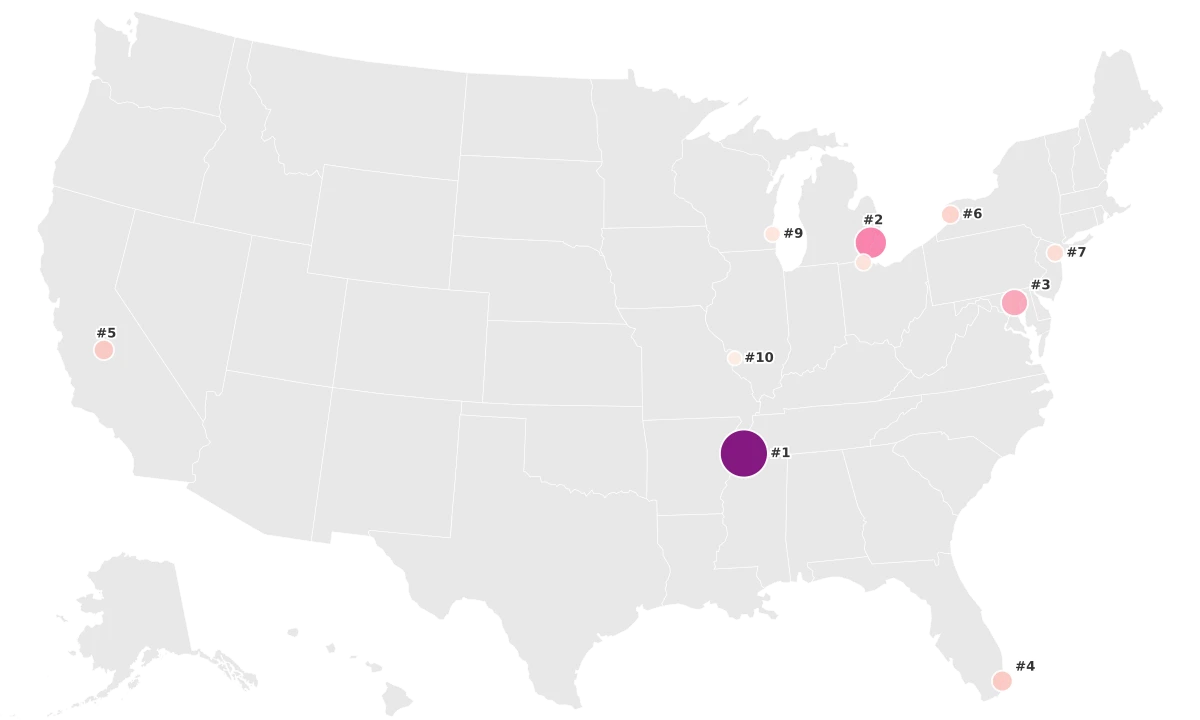
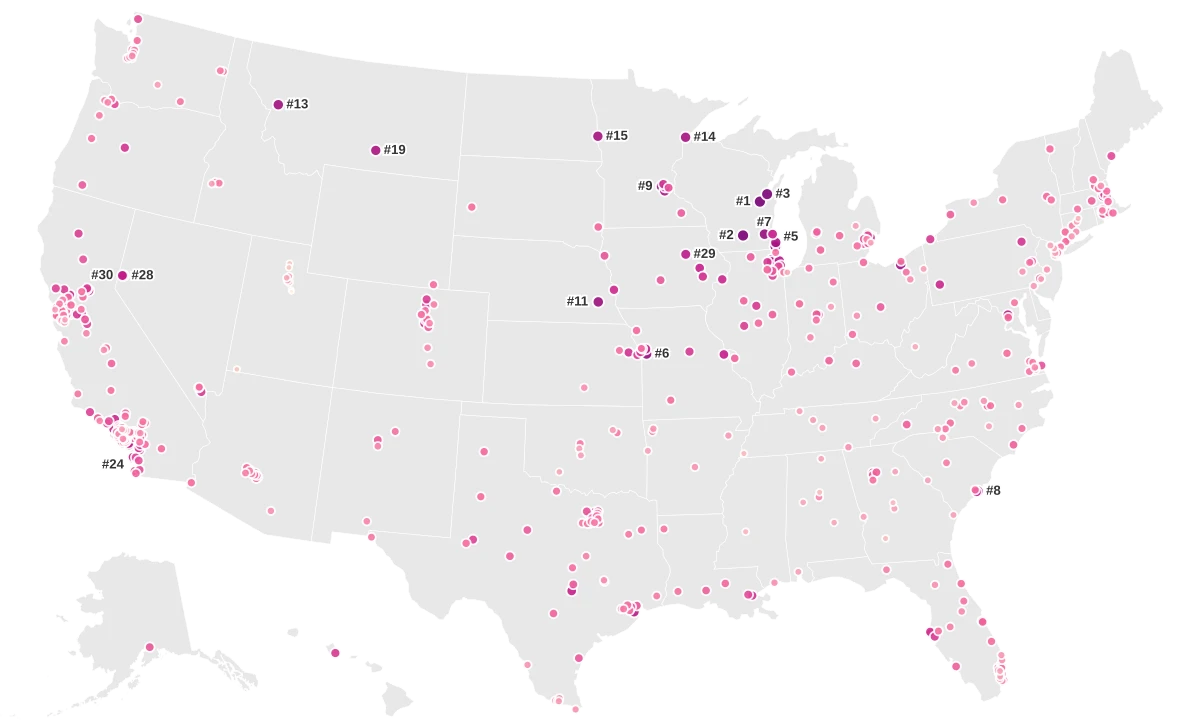
If you picked a random bar in Denver on a Friday night, there is a better chance someone at that bar just binge drank than in almost any other city in America. Denver leads the country at 25.9% of adults reporting binge drinking, according to the CDC's PLACES project, which draws on 2023 data from the Behavioral Risk Factor Surveillance System. Binge drinking means four or more drinks on a single occasion for women, five or more for men, at least once in the past 30 days.
Washington, DC is second at 24.0% and Missoula, Montana third at 23.9%. Two South Carolina cities follow: Mount Pleasant at 23.1% and Charleston at 22.9%, with Iowa City at 22.7% behind them. Wisconsin, which dominated the last version of this ranking, has slipped: Waukesha (21.9%) is seventh, Appleton (21.4%) ninth and Madison (20.8%) eleventh, while Green Bay has fallen to 68th and Milwaukee sits below the national average. Iowa and Illinois now place six cities apiece in the top 50, more than any other state.
At the bottom, the picture flips completely. Orem, Utah reports just 8.6%, one-third of Denver's rate, and Provo is right beside it at 8.7%. Five of the ten lowest-ranked cities are in Utah. The gap between the top and bottom of this ranking is 17.3 percentage points, but the middle is compressed: the mean is 16.1% and the median 15.9%, and most cities cluster within a few points of that number.
The upper Midwest and the Northern Plains still populate the top of the ranking, alongside Colorado, the Carolinas and the big college towns. The bottom is split between Utah and the Deep South. The reasons those two groups land in the same statistical neighborhood could not be more different.
The Drunkest Cities Are Not the Unhealthiest, but the Link Is Weaker Than It Was
The most counterintuitive finding in this data is what binge drinking does NOT correlate with. In most people's imagination, the "drunkest" cities would also be the cities with the worst health outcomes. The data says otherwise, though less emphatically than it used to.
Across these 491 cities, binge drinking runs only weakly in the opposite direction from smoking, and shows almost no relationship at all with poor mental health. The cities in the top quarter for binge drinking average a 12.3% smoking rate. The cities in the bottom quarter, outside Utah, average 14.2%. The direction is the one the old paradox predicts, but the distance is small.
The extremes still tell the story clearly. Denver pairs the highest binge drinking rate in the country with a smoking rate of just 10.3%. Mount Pleasant, South Carolina combines 23.1% binge drinking with a smoking rate of 7.7% and a poor mental health rate of 12.6%, both among the lowest in the dataset. Arlington Heights, Illinois and Plymouth, Minnesota show the same profile: well above average on binge drinking, 8.6% and 8.4% on smoking, and poor mental health rates under 13%.
The Cities That Drink the Most Do Not Report the Most Poor Mental Health Days
Binge drinking rates show almost no relationship with poor mental health across the 491 cities in the CDC dataset.
Now compare that to the other end. Albany, Georgia has one of the lowest binge drinking rates at 11.1%, but its smoking rate is 20.2% and its poor mental health rate is 20.4%. Memphis follows the same pattern: low binge drinking at 13.5%, paired with a 20.2% smoking rate and 20.7% poor mental health. Macon and Birmingham look similar, and Detroit pairs 11.8% binge drinking with the highest smoking and mental health burdens of any large city in the ranking. Across the bottom quartile of binge drinking, outside of Utah, the same profile repeats: cities that drink less are smoking more.
The explanation is socioeconomic, not behavioral. Binge drinking in the United States tracks with income, education, and whiteness. The communities where people drink the most tend to be the ones with the strongest economic foundations. Smoking tracks the opposite direction: with poverty, lower educational attainment, and chronic stress. These are not competing vices. They are markers of very different kinds of communities.
Utah and the Deep South Anchor the Bottom for Very Different Reasons
The bottom of this ranking contains two groups of cities that arrived at low binge drinking rates through entirely different paths. One group has some of the lowest smoking rates in the dataset. The other is among the most health-burdened.
Orem (8.6%) and Provo (8.7%) are both in Utah County, home to Brigham Young University and one of the highest concentrations of members of The Church of Jesus Christ of Latter-day Saints in the country. The LDS Church's health code, the Word of Wisdom, teaches abstinence from alcohol. Utah also maintains the strictest alcohol retail regulations in the country, with state-controlled liquor stores and tight licensing requirements. The cultural and regulatory effect is so strong that even Salt Lake City, which has a more diverse population, sits at 16.0%, right at the national average, and St. George and Layton join Orem and Provo in the bottom five.
The Utah cities also show very low smoking rates: 7.2% in Orem, 8.4% in Provo and Salt Lake City. Their mental health numbers are less flattering than they once were. Provo now reports a poor mental health rate of 21.5%, one of the higher figures in the dataset, and Salt Lake City 18.2%. Low substance use has not translated into low psychological distress there.
The Deep South tells a different story. Albany, Georgia (11.1% binge drinking), Jackson, Mississippi (11.8%), Macon (12.7%), Birmingham (13.1%), and Memphis (13.5%) all sit near the bottom for binge drinking. But their smoking rates are roughly double those of the Utah cities: Albany and Memphis at 20.2%, Jackson at 18.7%, Macon at 18.2%. Their poor mental health rates sit between 18% and 21%. Strong religious traditions, particularly in Black church communities, are widely cited by public health researchers as protective factors against alcohol use. But the communities themselves face high poverty, limited healthcare access, and chronic stress that manifest in other health burdens.
Both groups drink little. Only one group smokes little.
What This Survey Captures and What It Misses
The binge drinking numbers in this dataset come from the BRFSS, a telephone survey in which adults are asked how many times in the past 30 days they had four or more (women) or five or more (men) drinks on one occasion. That means every number here is self-reported, and self-reporting comes with well-documented biases.
In communities where heavy drinking carries stigma, people underreport. In communities where it is normalized, people may be more open. Denver's or Madison's binge drinking rate may be genuinely high, but it may also be partly a measurement artifact: a culture that treats drinking as ordinary is a culture that reports it more honestly. A deeply religious community in the Deep South or in Utah may have residents who undercount or omit drinking occasions when asked on a phone survey.
The definition itself also shapes what the data captures. A person who has two glasses of wine with dinner every night does not count as a binge drinker. A person who has six beers at a single tailgate event does, even if they only do it once a month. The metric measures episodic heavy drinking, not chronic alcohol consumption or dependence. Some of the lowest-ranked cities may still have significant alcohol-related health problems that this particular measure does not pick up.
The data year is 2023, published in the 2025 release of the CDC's PLACES project, which replaced the older 500 Cities program and estimates these rates for every incorporated place in the country. This page keeps the 500 largest cities from the original series, minus the Pennsylvania and Kentucky cities, because CDC did not release those two states' 2023 survey data. Set against the 2017 figures still available on this page, the shift is real: the Wisconsin cities that once led the country all fell by three to five points, while Denver, Washington and the Carolina coast moved up. Utah on the bottom is the one pattern that has not moved.