
















































































One Country in Four Is a Soldier
"Military size" is not a simple number. The figures in this ranking come from the International Institute for Strategic Studies' Military Balance 2025, and they combine three separate categories: active-duty soldiers who serve full-time, trained reserves who can be called up in a crisis, and paramilitary forces like border guards and civil defense corps. That total is very different from the number of people actually wearing a uniform on any given day.
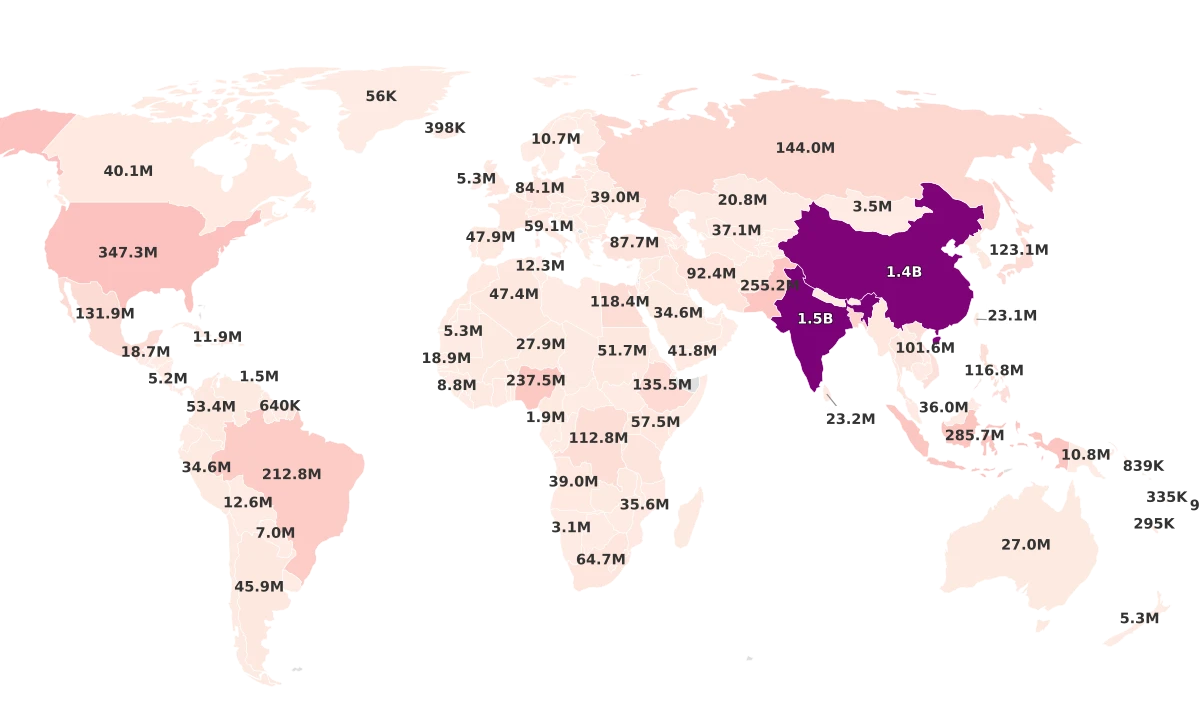
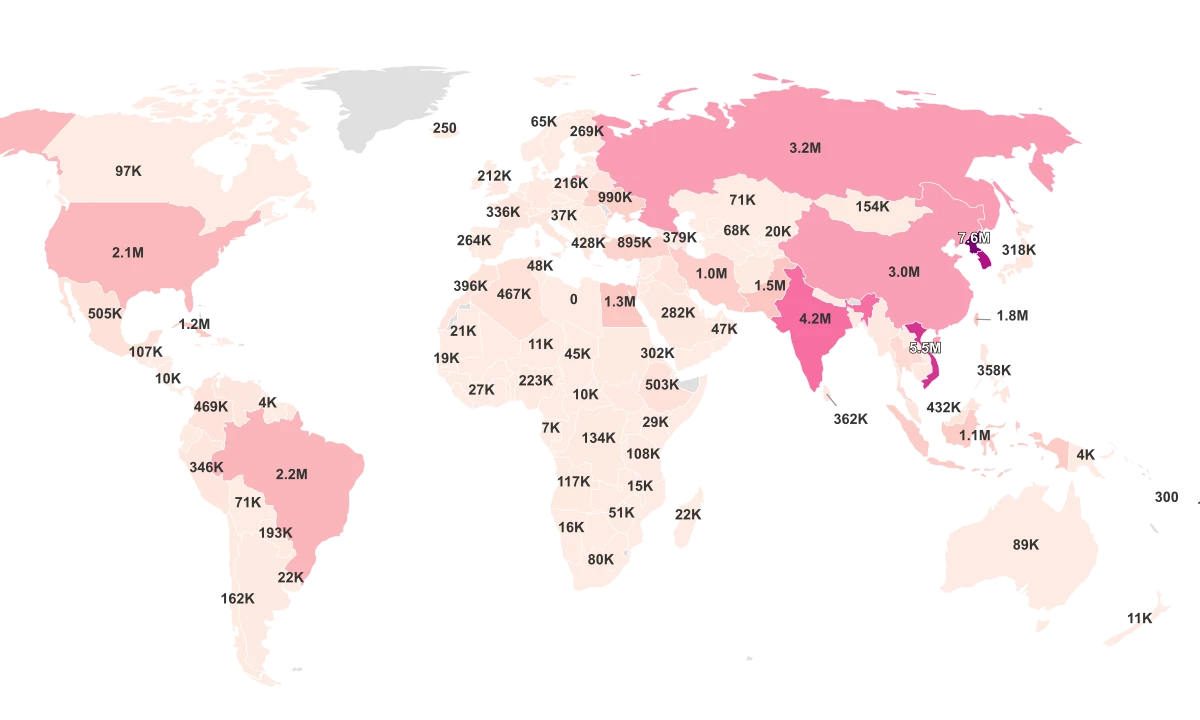
The range across 173 countries is staggering. North Korea leads with 7.58 million total military personnel. At the other end, Vatican City maintains a ceremonial Swiss Guard of 135. The global median is roughly 51,000, but the average is pulled up to 356,000 by a handful of enormous outliers at the top. Most countries cluster well below 100,000.
That concentration is extreme. Just five countries, North Korea, South Korea, Vietnam, India, and Russia, account for 44% of total military personnel worldwide: roughly 27.1 million out of 61.6 million. A handful of nations, including Iceland, Costa Rica, Panama, and Vatican City, maintain no active military at all. Costa Rica abolished its army in 1948 and redirected the budget to education and health care. Iceland relies entirely on NATO and a small coast guard.
The Korean Peninsula Is an Armed Camp
The two largest total military forces in the world face each other across a 250-kilometer border that has been frozen in armistice since 1953. The Korean War never formally ended. There is no peace treaty. That single fact explains why the Korean Peninsula dominates the top of this ranking.
North Korea fields 7.58 million total military personnel from a population of roughly 26 million. That means approximately one in four North Korean citizens is counted in this total. About 1.28 million serve on active duty, making it the world's fourth-largest standing army. The rest belong to reserve and paramilitary formations, most notably the Worker-Peasant Red Guards, a civilian militia numbering in the millions that receives basic military training. Under the regime's Songun, or "Military First," doctrine, the armed forces are the most important institution in the state: prioritized for food, fuel, and political power above all else.
South Korea's total of 6.61 million is built differently. Its active force of 500,000 represents the professional core. The remaining 6.1 million are trained reservists generated by universal male conscription: every South Korean man serves 18 to 21 months of active duty, then spends eight years in the reserve forces, and remains in civil defense until age 40. The pipeline is automatic. Every year, hundreds of thousands of men cycle through it. The result is a reserve pool that could flood the active force with trained personnel within days.
Vietnam rounds out the top three at 5.49 million total, built on a similar model. Its 450,000 active-duty soldiers are backed by roughly 5 million reservists and paramilitary members under a doctrine Hanoi calls "all-people national defense," a legacy of decades of continuous conflict from the 1940s through the 1970s.
The Biggest Armies Are Not the Most Powerful
If more soldiers meant more power, North Korea would be the most formidable military on earth. It is not. Composite power rankings, which weigh technology, logistics, economic capacity, and force projection alongside troop counts, tell a fundamentally different story.
The United States fields 2.11 million total military personnel, making it the eighth-largest force in the world. It ranks first in military power. China has 3.05 million and ranks second. Russia has 3.2 million and ranks third. But Germany, with just 214,000 total personnel, ranks fifth in power. The United Kingdom, at 211,600, ranks fourth. Both have smaller total forces than Cuba (1.23 million) and Belarus (444,900), neither of which cracks the top 25.
More Soldiers Does Not Mean More Power
Total Military Personnel vs. Global Power Rank across 89 countries. The weakest correlation in the dataset reveals that size alone explains almost nothing about overall military capability.
The pattern holds at every scale. Israel maintains 642,500 total military personnel and ranks 10th in power. Its strength comes from technological superiority: the Iron Dome missile defense system, advanced drone warfare capabilities, and one of the world's most experienced combat forces fed by mandatory conscription. Singapore, a city-state of 6 million people, fields 310,900 total personnel and ranks 23rd in power, ahead of nations ten times its size, because it spends heavily on advanced platforms like F-15SG fighters and stealth frigates.
The lesson the data repeats is consistent. Economic capacity to sustain, equip, and project military force matters more than the raw number of bodies under arms for determining overall power. A soldier without modern equipment, logistics, and institutional support is counted in the same column as one with all three.
Air Power Is Where the Real Gap Opens
If troop counts obscure the real balance of military power, aircraft inventories expose it. The United States operates 14,486 military aircraft across four branches: the Air Force, Army, Navy, and Marine Corps. The US Army alone flies more helicopters than most countries' entire air fleets. The US Navy is often described as the second-largest air force in the world.
Russia is second with 4,211 aircraft. China is third with 3,304. The American fleet is more than 3.4 times larger than Russia's and more than four times China's. After those three, the numbers drop sharply: India has 2,296 and Japan has 1,459. The top five countries hold 47.5% of all military aircraft on the planet: roughly 25,756 out of 54,207.
That concentration reflects spending, not just procurement. The United States allocates more to defense than the next several countries combined, and a disproportionate share goes to air power because American military doctrine is built around global force projection. Most nations design their air forces for homeland defense. The US designed its to fight anywhere in the world within hours. That requires not just combat aircraft but massive fleets of tankers, transports, and surveillance planes that most countries do not need and cannot afford.
Japan's presence at fifth is notable. Constitutionally limited to self-defense forces since 1947, Japan has quietly built one of the largest and most advanced air fleets in Asia, centered on F-35A stealth fighters and indigenous patrol aircraft. Its 1,459 aircraft place it above Pakistan (1,434) and South Korea (1,171), two countries with much larger total troop counts and active combat histories.
What the Numbers Leave Out
A ranking of "total military personnel" is useful, but it flattens distinctions that matter enormously. The 7.58 million figure for North Korea includes farmers and factory workers in the Worker-Peasant Red Guards who receive a few weekends of militia training per year. Cuba's 1.23 million includes 1.17 million reservists and a paramilitary "Youth Labor Army" alongside just 49,000 active-duty soldiers. These are real organizations, but they are not equivalent to a professional standing army.
Conscription models create another layer of complexity. Eritrea reports 301,800 total military personnel, and every single one is classified as active duty. The country's national service program, which the United Nations has called indefinite, drafts citizens for military and civil work with no guaranteed end date. Finland and Switzerland take a different approach: both maintain small active forces (23,900 and 19,600 respectively) backed by large trained reserves (245,000 and 196,400) through short-service conscription models. Finland deploys reservists for local defense; Switzerland arms them and sends them home with their rifles.
Taiwan illustrates how reserves reshape a ranking. Its active force of 169,000 is modest for a country that faces a direct military threat from mainland China. But its total of 1.84 million includes a massive trained reserve built through mandatory service, placing it ninth globally. The same logic applies to Israel, where 169,500 active personnel become 642,500 when reserves are counted, because the country can mobilize a large share of its civilian population within 48 hours.
These differences matter because "total military" as a single number suggests a comparability that does not exist. A Swiss reservist who trains two weeks a year is counted in the same metric as a US Marine on active deployment. Both are real, but they represent fundamentally different levels of readiness, capability, and cost.