Key Takeaways
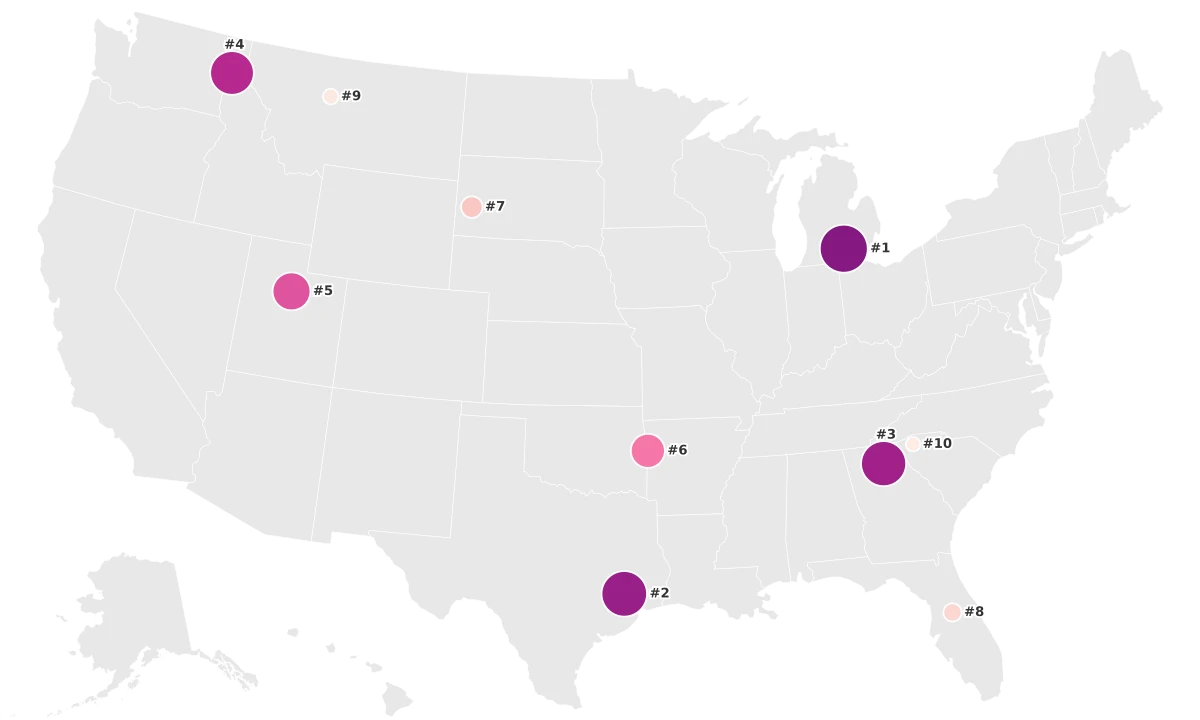
- Jackson leads the list, with about 72% of its residents counted as conservative.
- Greenville, South Carolina sits at the bottom of this group at roughly 58%, still a clear majority.
- The distance from first to last is only about 14 points, and the top four cities sit within two points of each other.
- The "conservative" figure is not one clean measure: it blends self-identification, Republican registration, and how cities voted in 2020.
One Word, Three Different Measures
The short answer to which city ranks most conservative is Jackson, where about 72% of residents are counted as conservative, with Greenville, South Carolina at the other end of this group near 58%. A higher number simply means a larger share leans conservative. It is a measure of political composition, the same way a city has a median age or a homeownership rate, not a verdict on the place.
Here is the part worth knowing before you read the table as fact. There is no official scorekeeper for a city's "conservative percent," and these particular figures come from a 2024 real-estate listicle rather than a polling firm. No data year travels with the numbers.
Look closely and the single column turns out to be three different things stitched together. For some cities it reports residents who call themselves conservative. For others, like Provo, it reports the share registered as Republican. For a few, including Rapid City and Greenville, it reports how the city voted in the 2020 presidential election. Those three measures usually point the same direction, but they are not the same thing, which is why this list is best read as one rough proxy.
The Most Conservative Cities Sit Close Together
The phrase "most conservative city" suggests a place in a category of its own. The data says otherwise. Every city here lands in a fairly narrow band, and the leaders are bunched almost on top of one another.
The top four cities, from Jackson down through Coeur d'Alene, are separated by less than two points. The distance from the single most conservative city to the least conservative on the list is only about 14 points. That is the real shape of this ranking: not a chasm between a reddest city and the rest, but a cluster of places that all lean the same way by similar amounts.
It helps to zoom out. Even nationally, self-identified conservatives only modestly outnumber liberals. Gallup found 35% of Americans called themselves conservative versus 26% liberal in 2017, an edge that had narrowed to single digits for the first time. Against that backdrop, a city where 58% lean conservative is already well above the national tilt, and one at 72% is not in a different universe from its neighbors on the list.
Faith and Open Country Do the Heavy Lifting
So what pushes a city toward the conservative end? Two patterns show up again and again in national survey work, and both are demographic rather than mysterious.
The first is religion. Pew Research finds that the only major religious groups in which about half or more identify as conservative are evangelical Protestants at 59% and Latter-day Saints at 56%. That helps explain a city like Provo, the home of Brigham Young University and a heavily Latter-day Saint population, sitting high on the list, and it fits the evangelical Bible Belt cities clustered in the South.
The second is geography. Pew's political typology shows that the most conservative-leaning groups are also the most rural, living in less-dense communities at well above the national average. Several cities here are small metros, suburbs, or exurbs rather than dense urban cores, the kind of places where that pattern tends to concentrate. Faith and open country, more than any single policy, do most of the explaining.
Ask a Different Pollster, Get a Different List
The honest caveat is that there is no settled answer to "which cities are most conservative," because the answer depends entirely on who is measuring and which cities they count.
A peer-reviewed study by researchers at MIT and UCLA, summarized by Pew Research, pooled seven large opinion surveys to score the 51 cities with more than 250,000 people. It named Mesa, Arizona the most conservative big city and San Francisco the most liberal. Not one of the cities on this list appears in that ranking, mostly because they are too small to clear the study's size cutoff.
That is the useful way to hold this table. It is a snapshot from one source, built on a mix of self-identification, party registration, and vote share, covering small and mid-sized cities that the rigorous academic surveys leave out. A gap of a point or two between cities here is noise, not a meaningful distinction. Read it as a rough guide to where conservative-leaning residents concentrate, not as a precise leaderboard.