

























































































Reading and Math Scores Across the OECD Have Never Been Lower
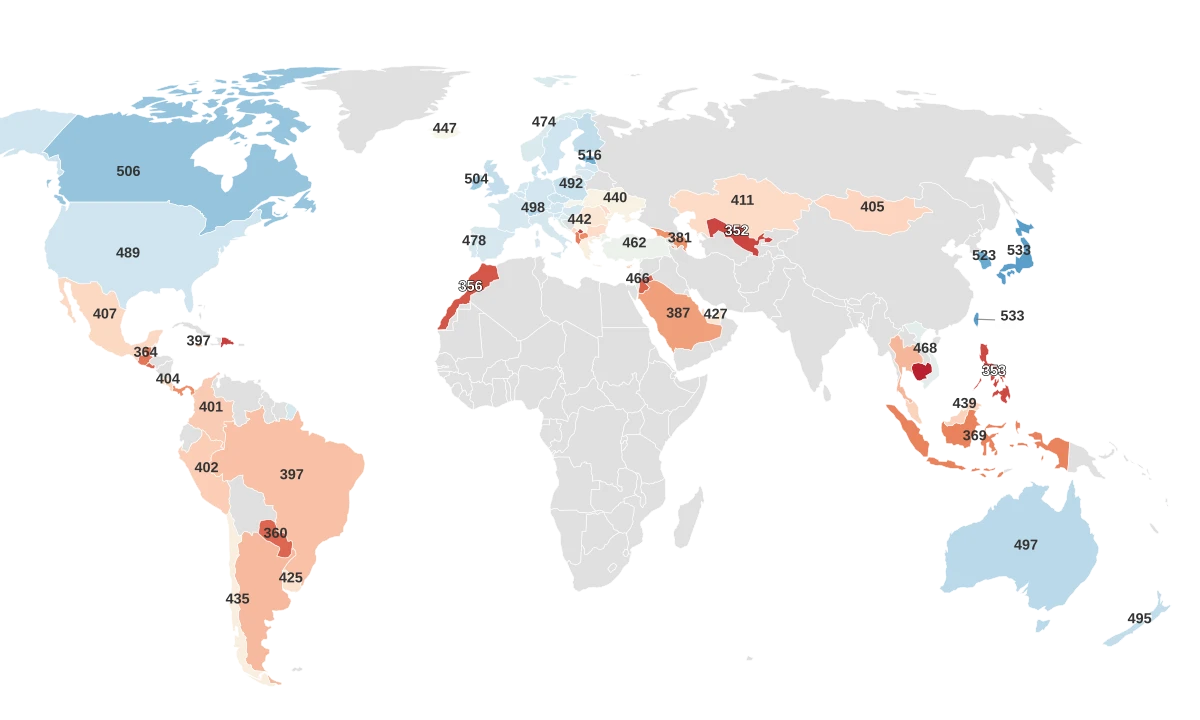
Every three years the OECD tests 15-year-olds on how well they can apply math, reading and science to real problems. The test is PISA, the Programme for International Student Assessment, and the 2025 cycle was the largest yet: roughly 760,000 students across 91 countries and economies. Science was the focus subject this round. The overall score on this page is the simple average of a country's science, reading and math results.
The headline is bleak. The OECD average now sits at 482 in science, 461 in reading and 463 in math. Reading and math are the lowest averages the OECD has ever recorded. Since 2015, the average reading score has fallen 28 points and math 22 points, which the OECD translates into roughly a year and a half of learning lost in reading and just over a year in math. Science was the one bright spot: stable between 2022 and 2025 after declining since 2009. One in five students across the OECD is now a low performer in all three subjects, up from 16% in 2022.
The decline is broad rather than concentrated. Of the 76 countries with results in both 2022 and 2025, 57 scored lower this time. Thirty-eight systems with at least four cycles of data posted their lowest overall score on record, a list that includes Germany (472), France (466), Canada (495), Sweden (472), the Netherlands (470), Norway (458), South Korea (516) and the United States (485).
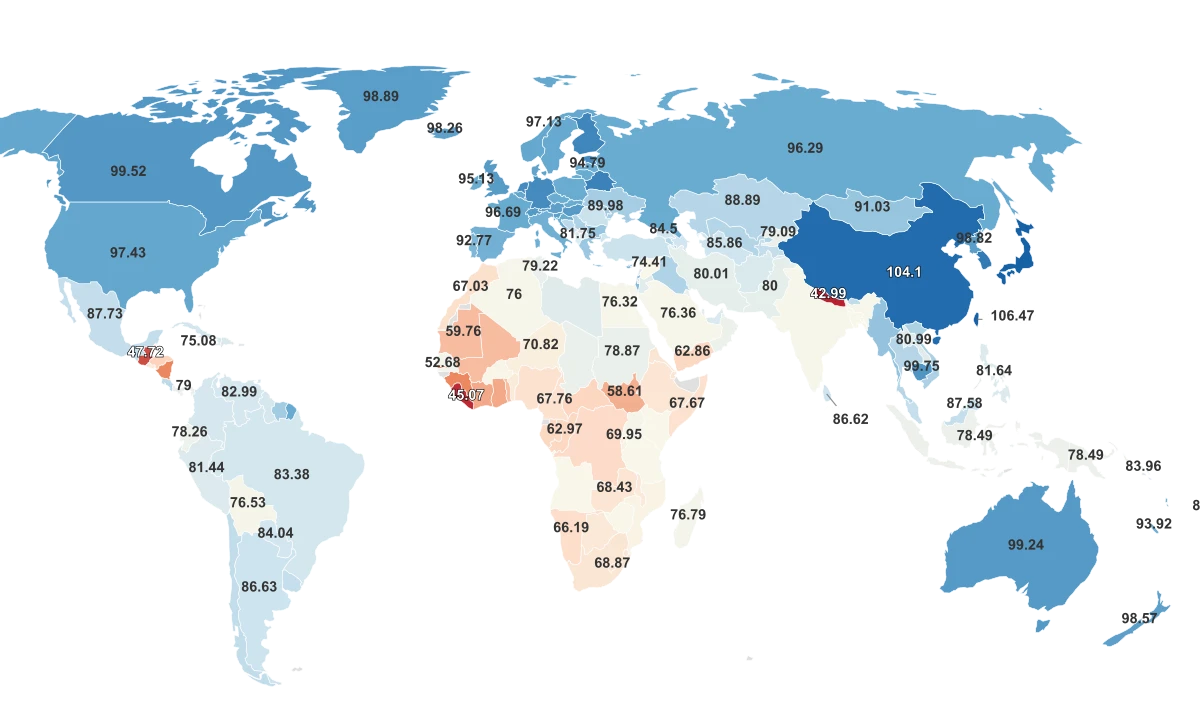
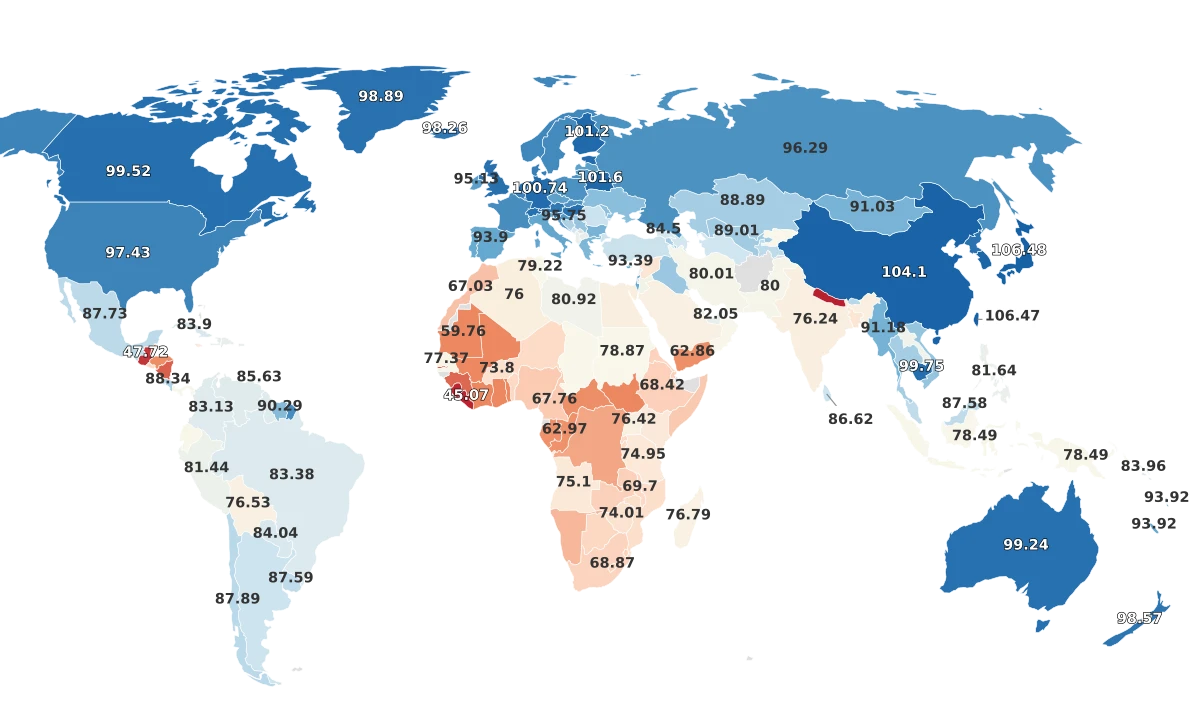
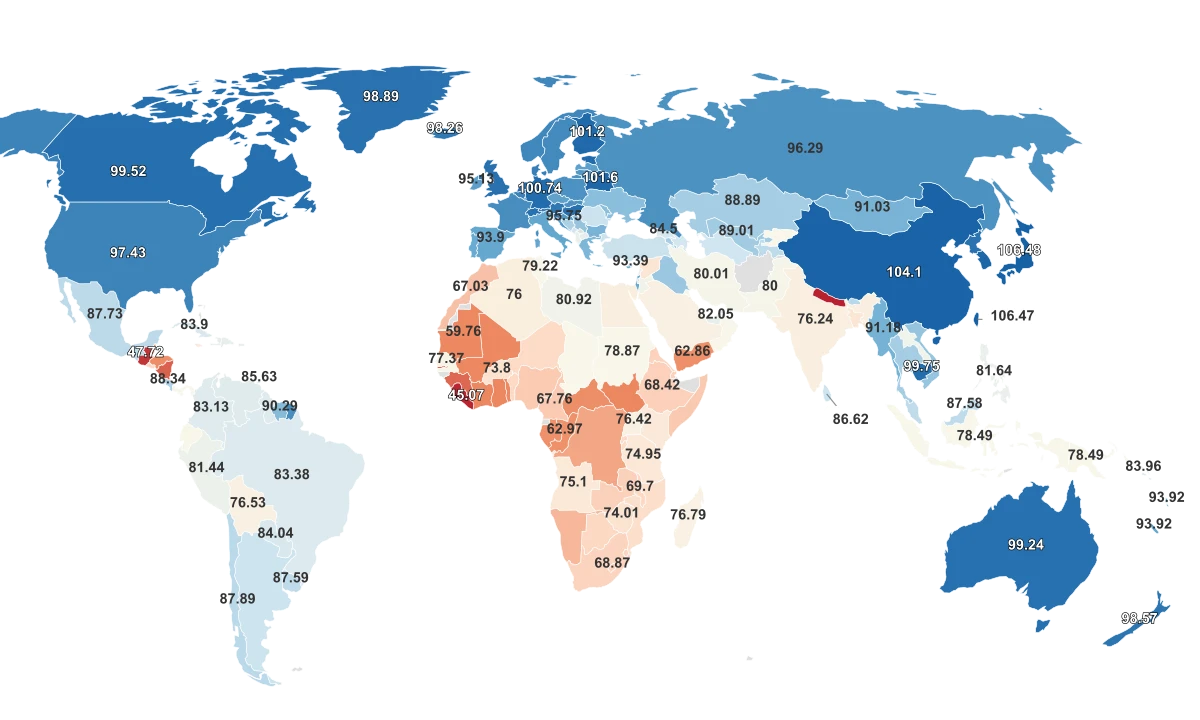
The spread between the top and bottom of the table is 269 points, from China at 579 to Rwanda at 310. By the OECD's own yardstick, where 28 points is about a year and a half of learning, that gap is more than a decade of schooling.
Most Countries Lost Ground Between 2022 and 2025
Largest changes in Overall PISA Score. Albania and Jordan recovered from 2022 collapses and Cambodia extended a three-cycle climb, while Latvia, Israel and Denmark posted their steepest falls yet.
Showing 51 of 78 regions · Sorted by: Biggest Change · 27 not shown
Four Chinese Provinces Are Back on Top, and Their Score Barely Moved
The China row on this page is not China. It is four provinces, Beijing, Shanghai, Jiangsu and Zhejiang, which the OECD reports as a single economy under the label B-S-J-Z. They did not take part in the 2022 cycle, and their absence let Singapore take the top spot. In 2025 they are back, and they are back exactly where they left off: 579 overall, against 579 in 2018.
The composition of that score is lopsided. B-S-J-Z scored 612 in math, the highest result any system has posted in any subject in this cycle, and 597 in science. In reading it managed 527. The 85-point gap between its math and reading scores is the widest in the entire dataset, and it is worth keeping in mind that four wealthy coastal provinces are being compared with whole countries. The OECD does not present the result as a national figure, and neither should readers.
Among national systems, Singapore remains first. Its 553 is down seven points from 560 in 2022, and the drop is concentrated in math, which fell from 575 to 563, and reading, down from 543 to 535. Science held at 560. Singapore still leads Taiwan, the next national system, by 22 points.
The rest of the top of the table is the familiar East Asian cluster: Taiwan at 531, Macau at 530, Japan at 522 and South Korea at 516. Every one of them scored lower than in 2022. The sharpest fall in the group belongs to Hong Kong, which slipped to 499 from 520 in 2022 and from a peak of 554 in 2012, its lowest score on record.
Estonia at 511 is the only European system in the top seven. The United Kingdom at 498 is ninth, one of two G7 members in the top ten alongside Canada (495).
Finland Has Fallen in Every PISA Cycle Since 2006
For a generation of education reformers, Finland was the model. It topped the first PISA rankings in 2000 and scored 553 overall in 2006. It has scored lower in every cycle since: 544 in 2009, 529 in 2012, 523 in 2015, 516 in 2018, 495 in 2022 and now 482. That is a 70-point decline over seven cycles, which by the OECD's yardstick is more than three years of learning.
The slide runs through every subject. Finnish math has fallen from 548 in 2006 to 469. Reading has gone from 547 to 474. Science, the country's historical strength, has dropped from 563 to 504, though it remains the best of Finland's three results and still ranks twelfth in the world. Finland now sits behind Poland (487), Ireland (493) and the United Kingdom (498), and its neighbour Estonia (511) has been Europe's top performer for the fourth cycle in a row.
Finland is not alone in the Nordics. Denmark fell 21 points to 469, Sweden dropped to 472 and Norway to 458. All three are at their lowest overall scores since PISA began. Denmark and Sweden now sit within three points of the OECD average of 469, and Norway 11 points below it.
The counter-example is the United Kingdom. It is one of only 19 countries to improve on its 2022 score, rising from 494 to 498, and the gain came entirely from science, which climbed from 500 to 511, eighth in the world. Reading (494) and math (488) were flat. The OECD's own reading of the results, from Secretary-General Mathias Cormann, is that the systems holding up are the ones that "focus on fewer areas in greater depth, invest in teachers, engage parents and provide targeted support for the students and schools that need it the most."
Latvia Lost 31 Points. Albania Gained 58. Neither Story Is Simple.
The steepest declines between 2022 and 2025 came from countries that had looked stable. Latvia fell from 484 to 453, a 31-point drop in a single cycle after nearly two decades of hovering near 485. Israel lost 28 points, falling to 437, its lowest score on record. Denmark dropped 21 to 469, Slovenia 22 to 463, Serbia 22 to 420 and Malta 24 to 435. Two of Europe's largest systems joined them: Germany slipped from 482 to 472 and France from 478 to 466, both record lows.
The largest gain in the table needs an asterisk. Albania rose 58 points, from 367 to 425. But Albania had collapsed by 52 points in 2022, and its 2025 result simply returns it to roughly where it stood in 2018. The OECD also flags Albania, along with Canada, the Netherlands, New Zealand, Norway and the United States, as a system where one or more sampling standards were not met, and advises caution when reading its estimate.
The more convincing recoveries are elsewhere. Jordan gained 27 points to reach 386 after a steep fall in 2022. Cambodia rose 28 to 365, its third consecutive improvement since it first sat the test in 2018. Georgia climbed 25 to 408 and the United Arab Emirates 21 to 448, its best result ever. Turkey posted 476, also a record, up 14 points. The OECD singles out Turkey, the Slovak Republic, Montenegro, Qatar and the UAE as systems that raised their share of top performers in science while cutting their share of low performers.
One large mover is missing from this account on purpose. Vietnam scored 431 in 2025, but the OECD publishes no earlier score for it on a comparable basis, so its apparent fall against the 2022 figure on this page should not be read as a trend.
The Composite Hides a 27-Point Split Inside the United States
PISA does not test one skill. It tests three, and the results diverge in ways the overall score conceals.
In science, the 2025 focus subject, the top of the table is China at 597, Singapore at 560, Macau at 541, Taiwan at 540 and Japan at 538. Estonia (527) and South Korea (526) follow, and the United Kingdom (511) is eighth, the highest-ranked English-speaking system.
In math the East Asian lead is even wider. China's 612 stands 49 points clear of Singapore's 563, and Macau, Taiwan, Japan, South Korea and Hong Kong fill the next five places. In reading the pattern cracks. Singapore leads at 535, ahead of China at 527, and Ireland at 500 sits within a point of South Korea and Macau. Ireland is one of the few high performers whose reading score (500) exceeds its math score (480) by a wide margin.
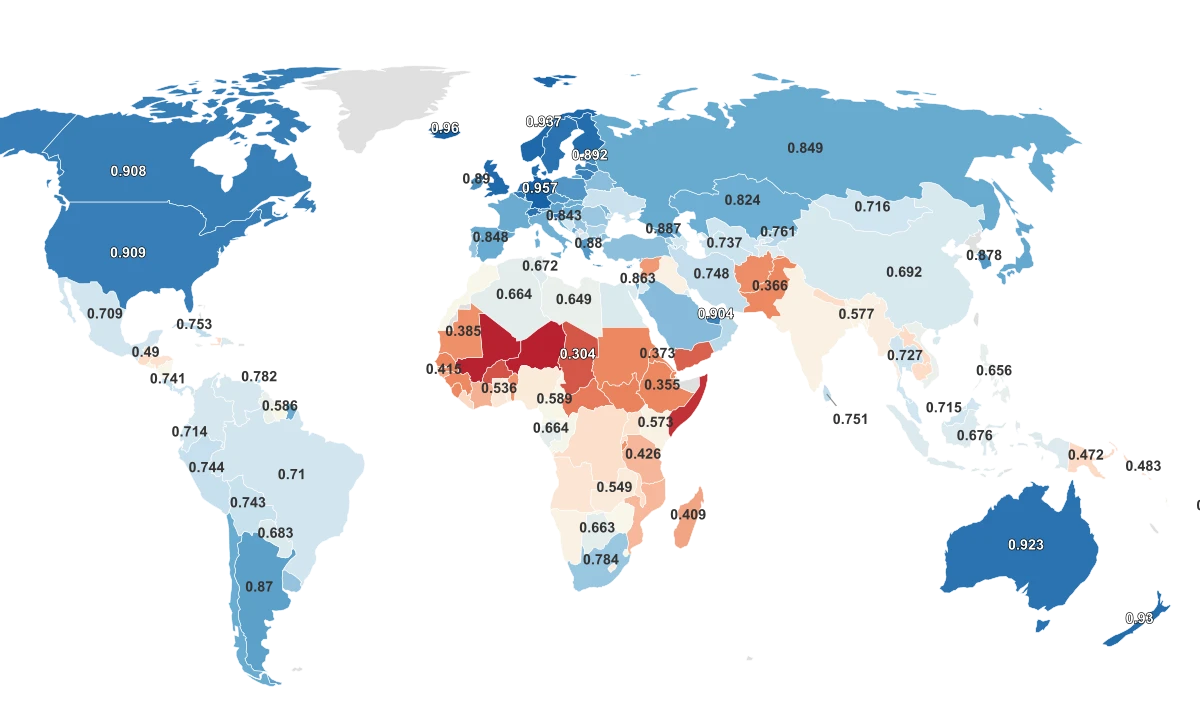
The United States illustrates the subject split more sharply than any other large economy. It scored 490 in reading but only 463 in math, a 27-point gap that is more than a year of learning by the OECD's measure. Chile (436 reading, 403 math) and Brazil (408 and 377) show the same tilt. The opposite profile is just as common. China's 85-point math advantage over reading is the extreme case, but Vietnam (443 math, 392 reading), Macau (549 and 501) and Azerbaijan (422 and 374) all outscore their own reading results by close to 50 points in math.
The 2025 cycle also added a fourth domain, computational problem solving, which is not part of the overall score on this page. Across the OECD, almost two-thirds of students reached the proficiency threshold in it, but only half did so while also reaching basic proficiency in science, reading and math. The OECD's conclusion is that the two are not substitutes: foundations in the core subjects still decide whether digital skills are worth anything.