
















































Key Takeaways
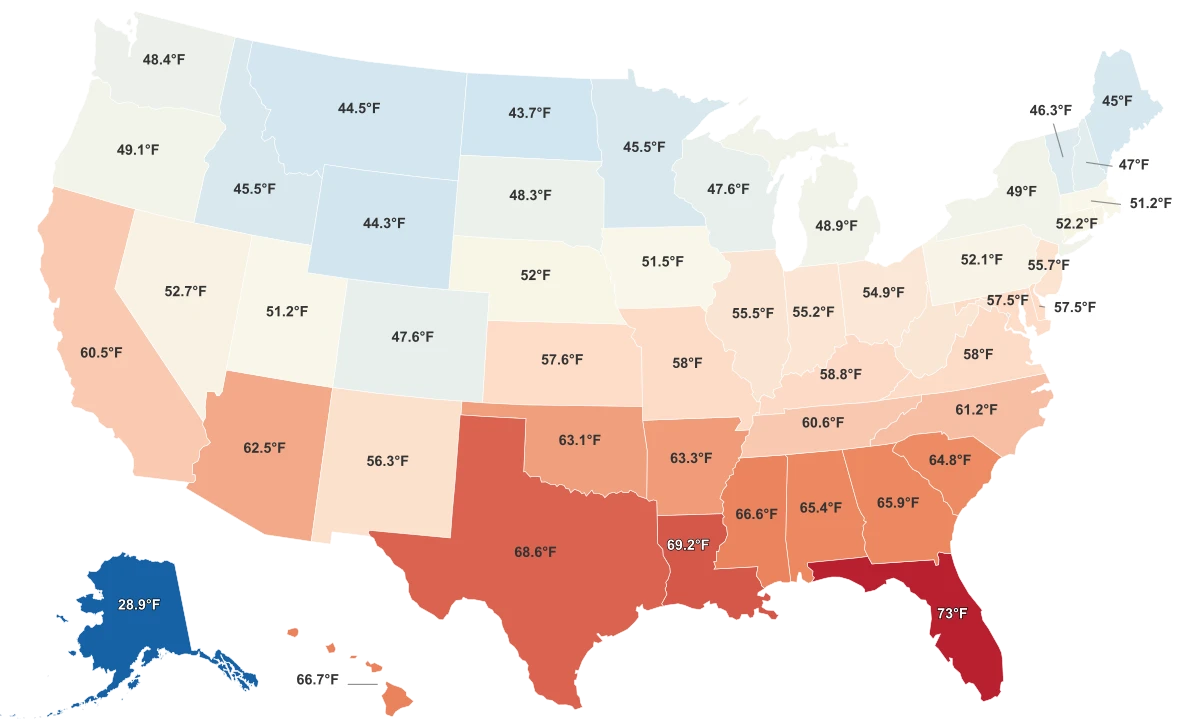
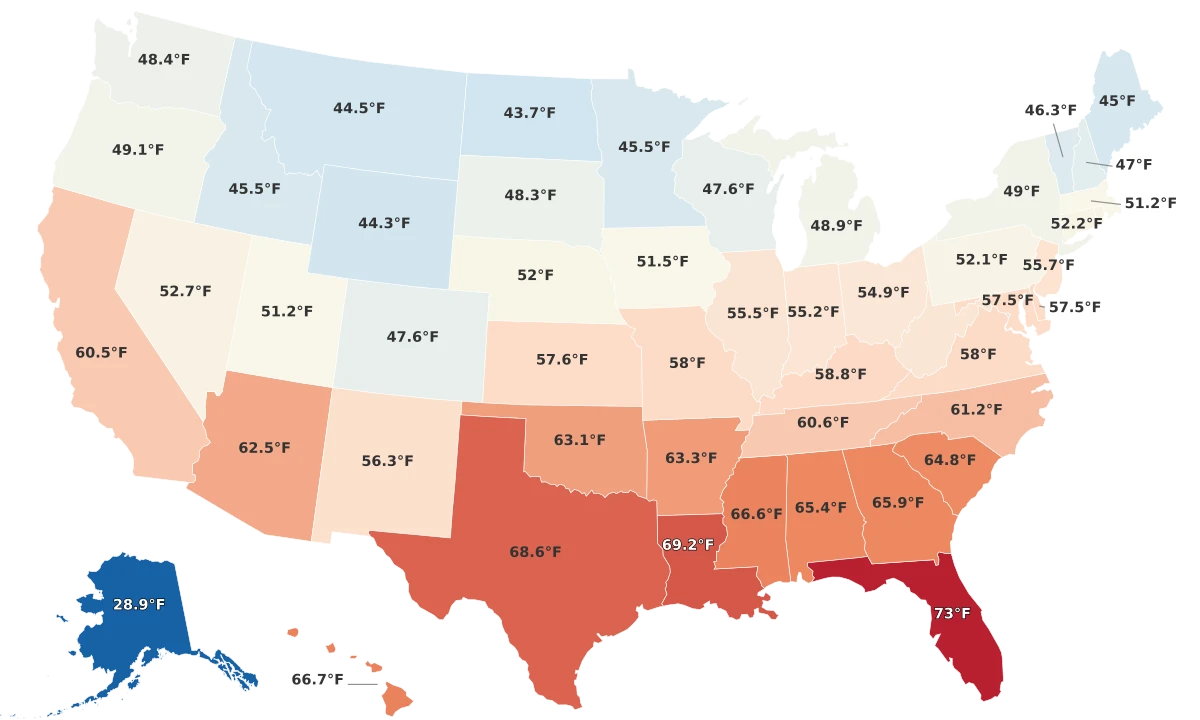
- Florida has the warmest weather by average temperature, at 73.0F in 2024.
- Alaska is the coldest by a wide margin, at 28.9F, the lone extreme in the dataset.
- The spread from Florida to Alaska is 44 degrees, but almost every other state sits between the mid-40s and low-70s.
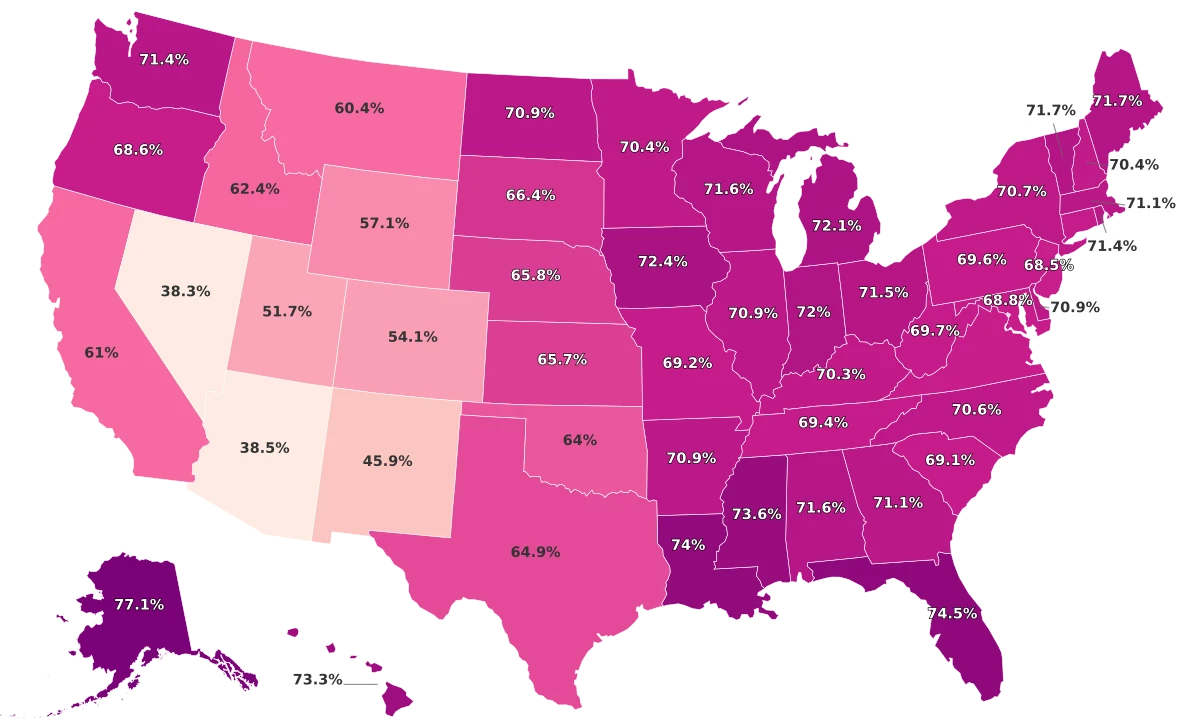
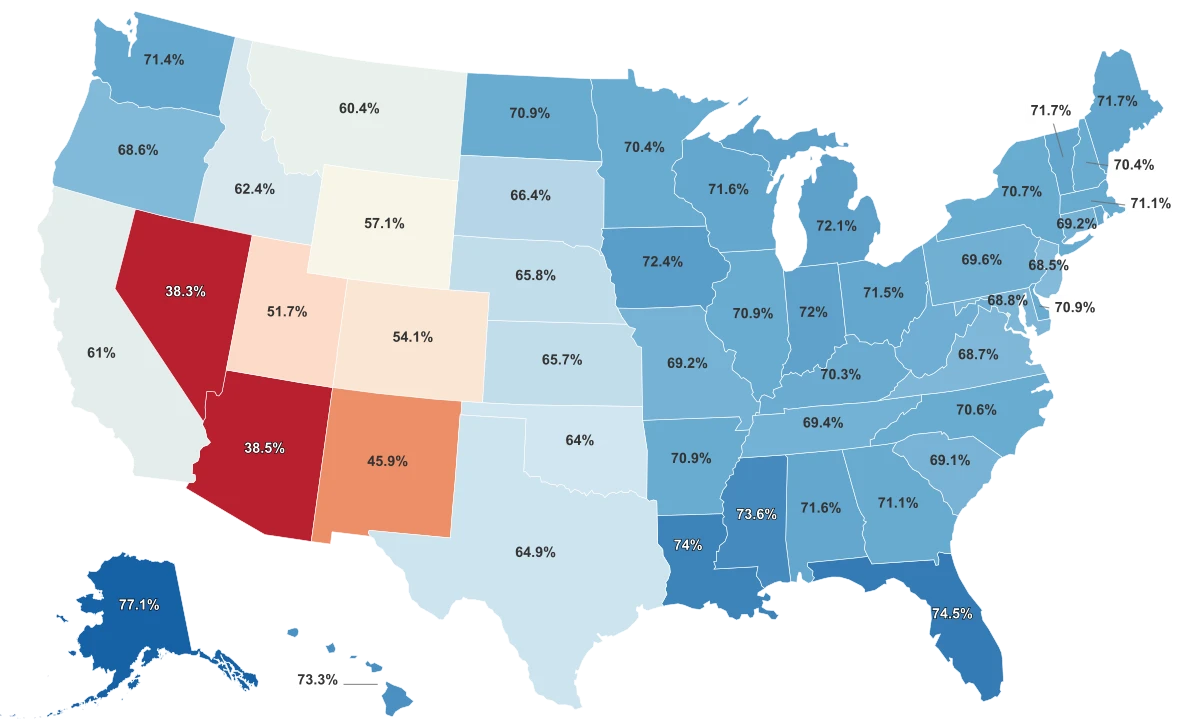
- Warmth says nothing about how muggy a state feels: the most humid state of all is Alaska, the coldest.
Hawaii Is Not Even in the Top Three
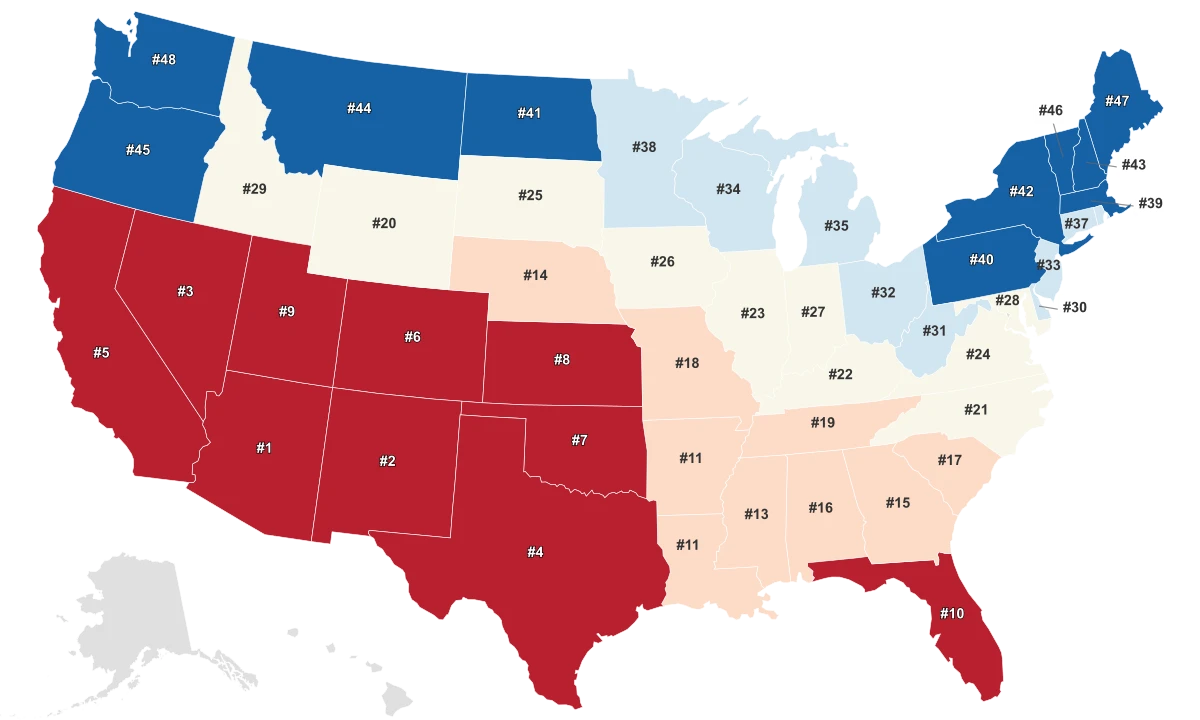
Ask which state has the best weather and most people picture Hawaii. By average temperature, it does not even make the podium. Florida is the warmest state at 73.0F, with Louisiana and Texas next; Hawaii sits fourth at 66.7F, a few tenths of a degree warmer than Mississippi. At the cold end, Alaska averages just 28.9F, the lowest in the country by a wide margin.
These numbers are mean annual temperature in degrees Fahrenheit for 2024, from NOAA's National Centers for Environmental Information. They come from the agency's climate divisional database, which rolls up station readings into a single yearly figure for each state. It is an official federal climate record, not a survey or a comfort score.
That distinction matters for a page about "best" weather. This ranking sorts states by warmth, and warm is not a synonym for good. A higher number means a hotter year on average, which a snowbird and a hiking enthusiast would judge very differently. The number tells you the temperature. It does not tell you whether you would want to be outside in it.
Warm Tells You Nothing About Muggy
The first thing people actually feel about weather is not the thermometer alone, it is the mugginess. So you might expect the hottest states to also be the stickiest. They are not. Across all 50 states, average temperature and relative humidity have almost no relationship at all, and the link is not statistically meaningful.
The proof is in the Southwest. Arizona and Nevada are among the hottest states in the country, yet they are also the driest, sitting near 38% average humidity. The National Park Service ties this to the region's place between two atmospheric circulation belts, which delivers year-round warmth, low precipitation, and clear skies at the same time. Heat and dryness arrive together there, not as opposites.
Hotter States Are Not Stickier States
Average temperature and relative humidity scatter into a shapeless cloud, with no trend linking how warm a state is to how muggy it feels.
Then there is the fact that breaks the whole assumption. The most humid state in the country is Alaska, the coldest one. Climatologist Brian Brettschneider explains that relative humidity is temperature-dependent: cold air holds little moisture, so it saturates easily and reads as high humidity even when the actual moisture is low. It is why he calls relative humidity a poor measure of how moist the air really feels, and why a warm ranking can never double as a comfort ranking.
A Sunny State Can Still Be Cold
If humidity is a dead end, sunshine looks more promising. Sunnier places do tend to be warmer, and the data backs that up, but only partway. Across the states with sunlight figures, the amount of annual sunlight a state receives explains roughly a third of the difference in average temperature. That is a real pull, not a coincidence, yet it leaves most of the variation unexplained.
The reason is that sunshine and warmth are loosely coupled, not locked together. A state can bank a lot of clear days and still run cold, because elevation, latitude, and how dry the air is all push back against the sun. The count of sunny days does even less work than total sunlight, explaining only about 15% of the temperature spread, and its underlying figures carry no listed source, so it is best read as a hint rather than a driver.
You can see the loose fit in the leaderboard. The sunlight figures, drawn from 2019 Stacker data, put Arizona and New Mexico at the top for sunshine, and both rank among the warmer states. Yet neither reaches Florida's warmth, and Colorado, which gets more sunlight than Florida does, sits near the bottom of the temperature table. Sunshine helps. It does not decide the ranking.
Only the South Breaks From the Pack
Step back from individual states and the country splits into one warm region and a tightly bunched everywhere-else. The South averages 63.0F, while the Midwest, West, and Northeast all land within about a degree and a half of 50F. There is essentially one region that breaks away on warmth, and three that are hard to tell apart.
The cause is latitude with a maritime assist. The Paleontological Research Institution notes that southern temperatures simply decrease as you move north, because lower latitudes collect more of the sun's heat over a year, with the warmest readings in Florida, Georgia, and Mississippi. Air that has crossed the Gulf of Mexico rarely turns extreme, which keeps the South both warm and steady.
The shape of the data tells the rest. Strip out the regional labels and nearly every state falls into one continuous band from the low-70s down toward the mid-40s. Then comes Alaska, alone, more than 14 degrees colder than the next-coldest state. For a question as subjective as "best weather," the one thing the temperature map states without argument is where the country's single climate outlier lives.