













































From 3 to 15: What the World Reports
Every number in this ranking is something a person typed into an online survey about their own sex life. That distinction matters more here than in almost any other dataset, because the gap between what people report and what actually happens is wider on this topic than on nearly any other subject researchers try to measure.
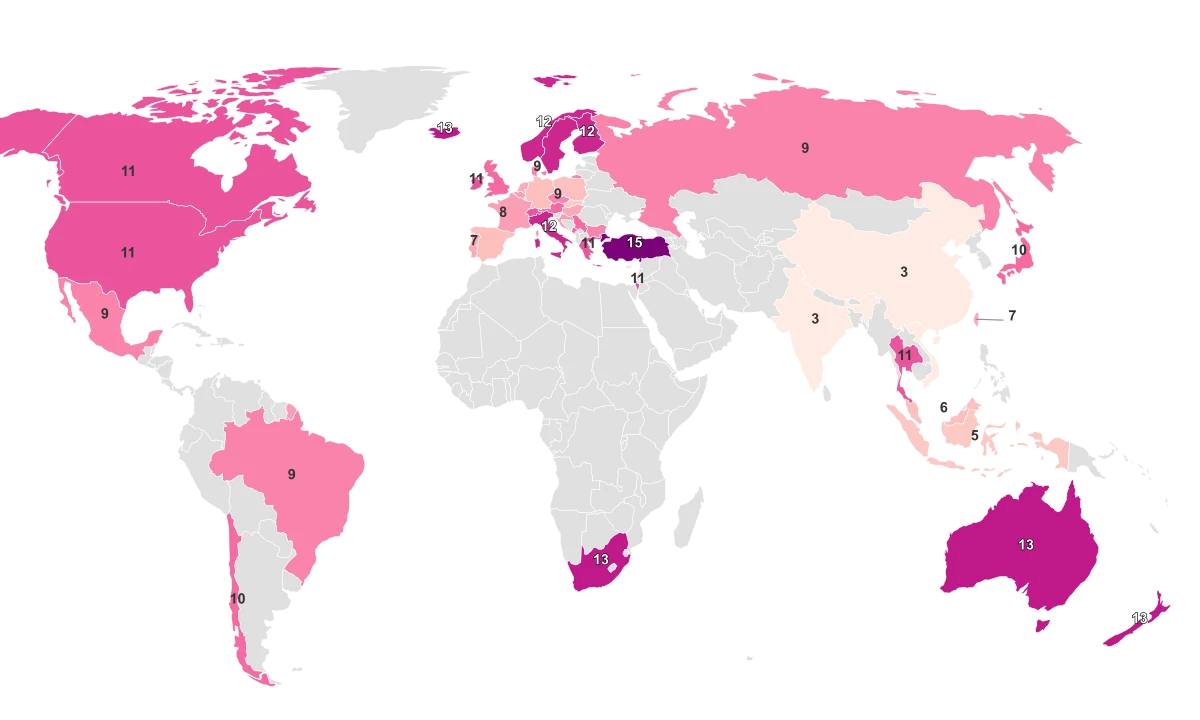
The data comes from a 2021 survey by Manual, a men's health company, covering 46 countries. Turkey leads the ranking at 15 average lifetime sexual partners. Four countries tie for second at 13: New Zealand, South Africa, Iceland, and Australia. At the other end, China, Vietnam, and India all report an average of just 3, making them the lowest in the dataset by a wide margin.
The global average across all 46 countries is approximately 9 partners, with the mean and median nearly identical. That symmetry means the distribution is unusually even: most countries cluster between 6 and 12, with a handful of outliers pulling the extremes apart. The full spread from top to bottom is 12 partners, roughly the difference between reporting one new partner per year of adult life versus one every seven years.
Between the extremes, the middle of the pack holds few surprises. The United States and Canada both report 11. The United Kingdom reports 10. France reports 8.
The Scandinavian countries sit slightly above average, with Sweden and Norway both at 12. Southern Europe trends lower: Spain at 6, Portugal at 7. Germany, despite its reputation for liberal attitudes, also reports 6.
The Numbers Reveal Culture, Not Behavior
Turkey's position at the top of this ranking is almost certainly not a reflection of Turkish people having more sex than anyone else. It is a reflection of how Turkish men answer surveys about sex. Turkey has a conservative, patriarchal culture where premarital sex is heavily stigmatized for women but where male sexual experience is often treated as a marker of masculinity. Researchers at the University of South Florida have described this dynamic as a "cultural closet," where public conservatism coexists with private behavior that surveys struggle to capture accurately.
The pattern at the bottom of the ranking mirrors the same problem in reverse. China, Vietnam, and India all report 3 partners, the lowest in the dataset. All three countries have strong cultural norms around marriage as the primary or exclusive context for sexual activity. In India, premarital sex remains heavily stigmatized in much of the country, particularly for women. In China, rapid urbanization has shifted attitudes among younger generations, but survey respondents still face social pressure to report conservatively.
This bias is not speculation. A widely cited study at Ohio State University found that when women were connected to what they believed was a lie detector, their reported number of sexual partners increased significantly compared to women who filled out anonymous questionnaires. The conclusion was straightforward: people adjust their answers to match what they think the interviewer, or their culture, expects to hear.
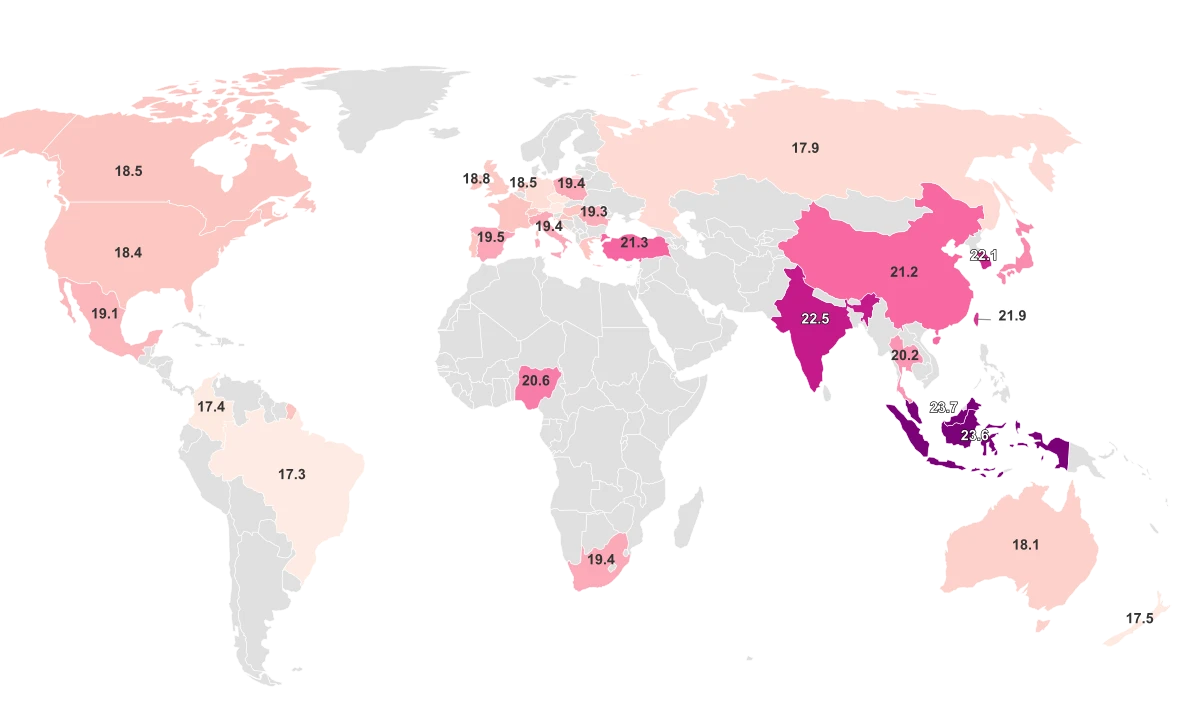
The age-of-first-sex data reinforces this cultural divide. Malaysia and Indonesia report the latest average age to lose virginity in the dataset: 23.7 and 23.6 years respectively. Both are Muslim-majority countries where premarital sex carries severe social consequences. At the other end, Brazil (17.3 years), Austria (17.5), and New Zealand (17.5) report the earliest, a gap of more than six years between the latest and earliest countries. Countries where people start earlier tend to report more lifetime partners: the two metrics track in opposite directions across the dataset.
More Partners Does Not Mean More Disease
The most counterintuitive finding in this dataset is what happens when you compare partner counts to STD rates. The answer is: almost nothing. The two metrics show essentially no statistical relationship across the 45 countries where both are available.
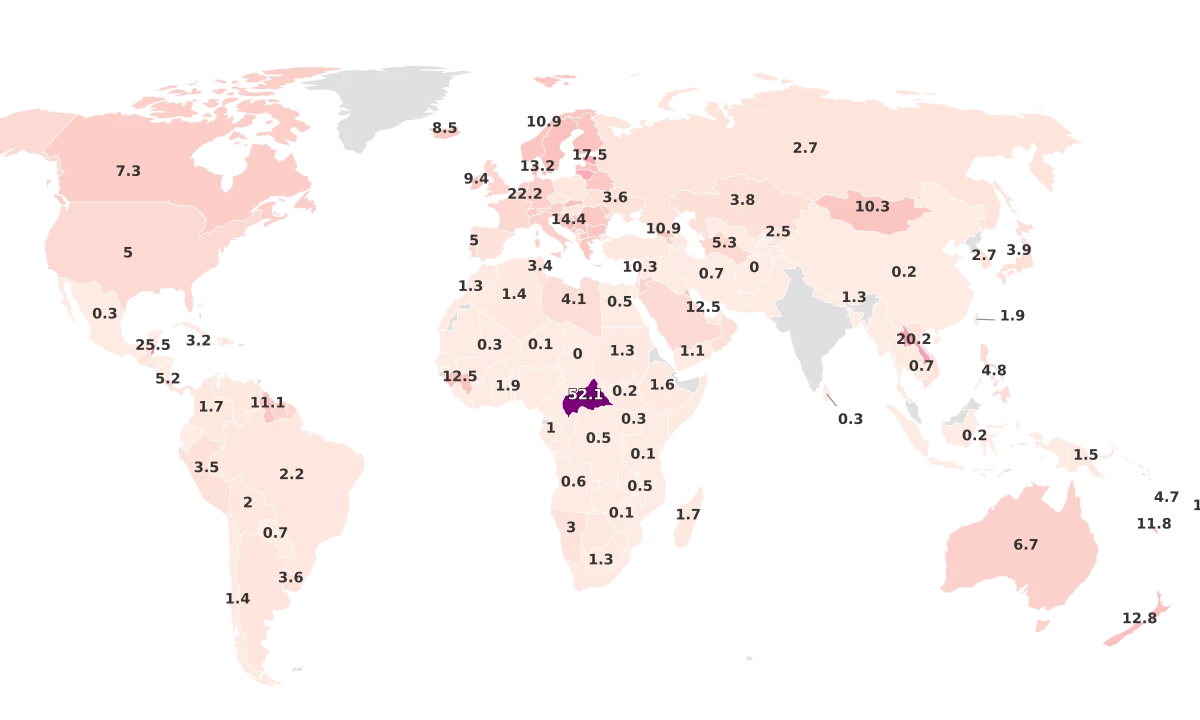
South Africa reports 13 average partners and an STD rate of 44,000 per 100,000 people, the highest in the world. Iceland also reports 13 partners but has an STD rate of just 12,200 per 100,000, roughly a quarter of South Africa's burden. At the bottom of the partner ranking, India reports only 3 lifetime partners but still carries an STD rate of 11,300 per 100,000, nearly as high as Iceland's despite reporting a fraction of the sexual activity.
Partner Count Does Not Predict STD Rates
Countries with identical partner averages show wildly different STD burdens, driven by healthcare access, HIV prevalence, and structural inequality rather than individual behavior.
The reason is structural. STD rates at the national level are driven by factors that have little to do with how many partners the average person reports. In Southern Africa, the world's highest STD cluster sits in a band of countries shaped by the legacy of apartheid-era labor migration, which disrupted family structures and created extensive sexual networks.
Botswana (41,200 per 100K), Lesotho (40,600), and Eswatini (39,000) all have STD rates roughly double that of the United States (20,400 per 100K), despite none of them appearing in the partner-count dataset at all. The common thread is not promiscuity. It is poverty, the HIV epidemic, and fragile healthcare systems that leave infections untreated for years.
What drives those numbers is not how many partners people have. It is whether condoms are available, whether untreated STIs go undiagnosed for years, whether HIV co-infection amplifies transmission, and whether healthcare systems can deliver consistent testing and treatment. The CDC and UNAIDS have both documented that concurrent partnerships, gender-based violence, and poverty are far stronger predictors of national STD burden than aggregate partner counts.
What This Data Can and Cannot Tell You
The source of the primary metric is Manual.co, a UK-based men's health startup. The survey was published as part of a content marketing report called "Male Milestones: Men in Numbers." No information is publicly available about sample sizes per country, whether respondents were exclusively male or mixed-gender, how "sexual partner" was defined, or what sampling methodology was used.
That matters because the best-quality national sex surveys in the world produce different results when they use rigorous methods. Britain's National Survey of Sexual Attitudes and Lifestyles (NATSAL), a probability-based study conducted by University College London and the London School of Hygiene and Tropical Medicine, is considered one of the gold standards in the field. It uses face-to-face interviews and computer-assisted self-completion for sensitive questions, a method designed to minimize both interviewer bias and social desirability effects.
The "Average Age to Lose Virginity" metric comes from a separate source: Reckitt Benckiser's "The Face of Global Sex" report from 2012, a consumer survey conducted by the parent company of Durex condoms. It covers only 37 countries and is now more than a decade old. Attitudes toward premarital sex have shifted measurably in many of those countries since the data was collected, particularly among younger cohorts in East and Southeast Asia.
The ranking is useful as a rough illustration of how cultural norms around sexual disclosure vary across countries. It is far less useful as a measure of actual sexual behavior. The countries at the top are not necessarily having more sex. The countries at the bottom are not necessarily having less. What the data captures most reliably is not what people do, but what they are comfortable telling a stranger they did.