An 87-Point Gap from the Whitest City to the Least White
The U.S. Census Bureau measures race and ethnicity as two separate questions. "White Alone, Not Hispanic or Latino" counts people who selected only White as their race and indicated they are not of Hispanic or Latino origin. That distinction matters: a person of Cuban or Mexican heritage who checked "White" on the race question is excluded from this category if they also identified as Hispanic.
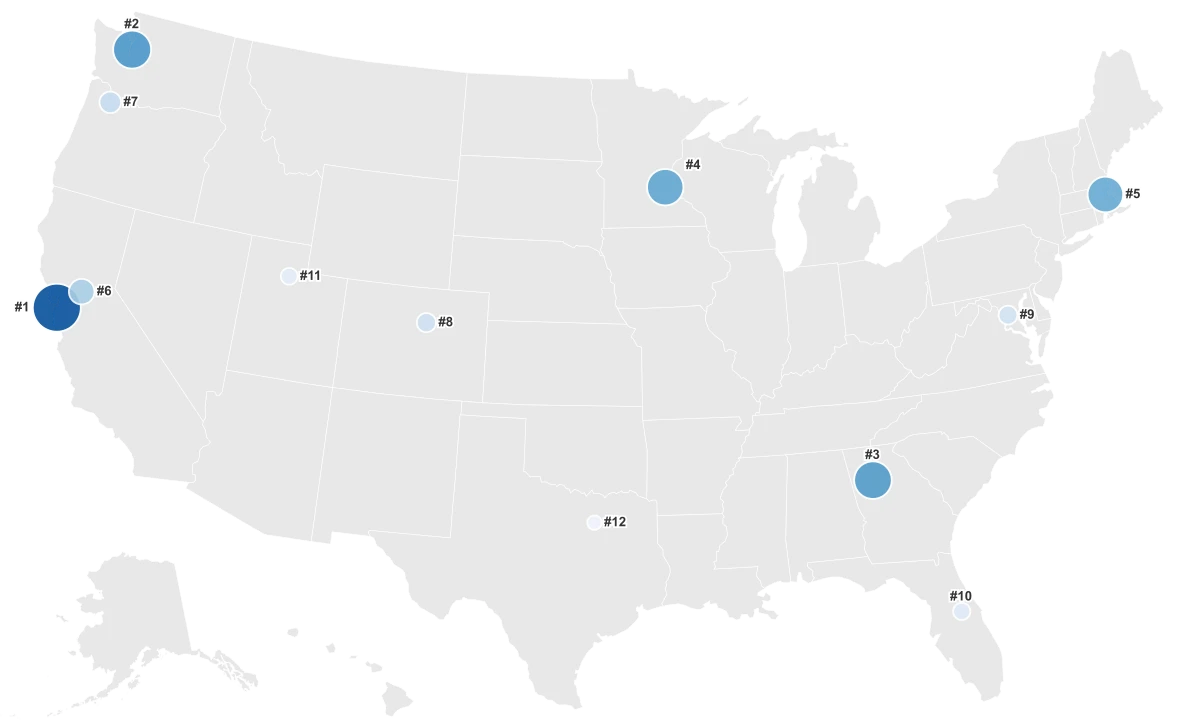
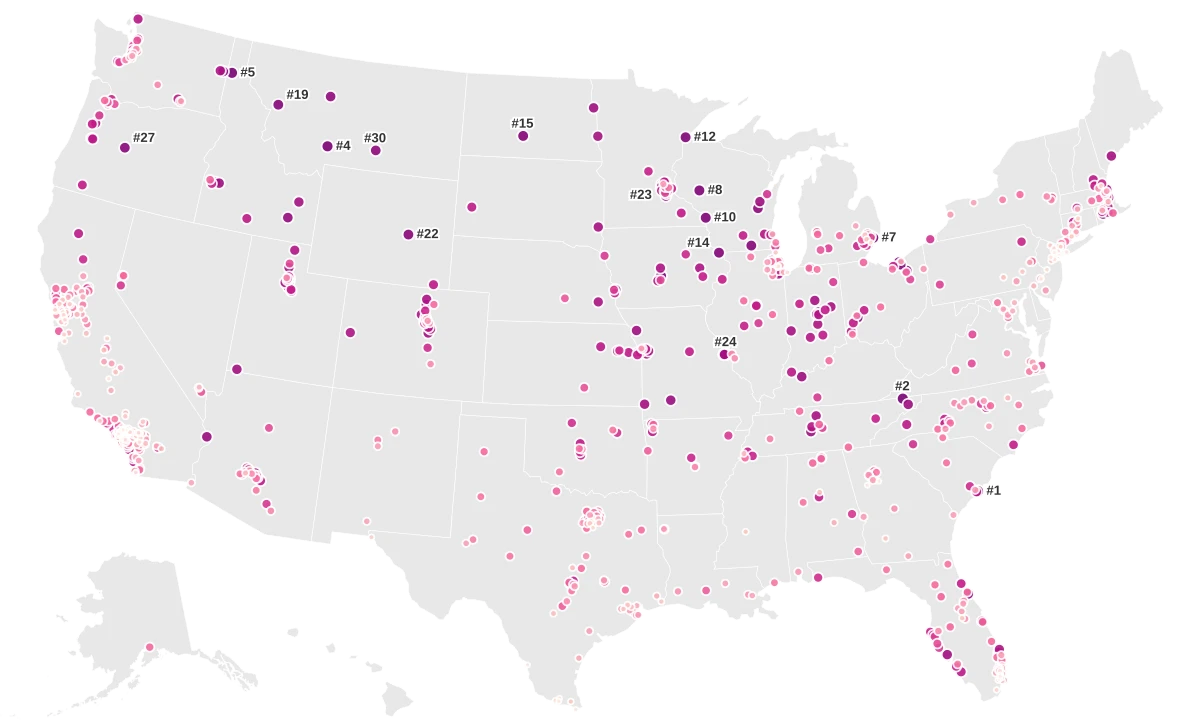
This ranking covers 787 American cities with populations above 50,000, all drawn from the 2020 Decennial Census. Mount Pleasant, South Carolina leads the dataset at 87.53%. At the other end, Compton, California sits at just 0.89%. The gap between first and last is nearly 87 percentage points.
The average white share across the dataset is 48.69%. The median is nearly identical. The typical American city in this size range is roughly split down the middle, but the extremes tell a different story.
Thirty-eight cities top 80% white. Forty-seven fall below 10%. The dataset captures virtually the entire spectrum of racial composition in American urban life.
The Whitest Cities Are Almost Never the Biggest
Every city in the top 10 has fewer than 110,000 residents. Ankeny, Iowa sits just outside Des Moines. Bozeman, Montana grew up around a state university in the Gallatin Valley. Coeur d'Alene, Idaho hugs a lake in the northern panhandle.
Among cities above half a million, Portland, Oregon has the highest white share at 66.43%. No other big city breaks 60%. Among the 10 largest, not a single one exceeds 45%.
The pattern has deep roots in federal policy. In the 1930s and 1940s, the Federal Housing Administration issued mortgage guidelines that explicitly favored white neighborhoods and restricted lending in areas with minority residents. Between 1945 and 1959, African Americans received less than 2% of all federally insured home loans. Historian Richard Rothstein documented in The Color of Law how these policies steered white homebuyers into newly built suburbs while blocking Black families from following.
That sorting persists. Midwest and Mountain West cities that did not attract large waves of post-1965 immigration remain overwhelmingly white. Demographer William Frey at the Brookings Institution has noted that these metros simply lack the job growth to attract new residents. The Latino, Asian, and immigrant populations who diversified Sun Belt cities over the past two decades largely bypassed the Midwest.
When the Census Counts You as White, but You Are Not
Dearborn, Michigan ranks sixth on this list at 85.37% white. It is also the first Arab-majority city in the United States, with more than half of its residents identifying as having Middle Eastern or North African ancestry. Those two facts are not contradictory. They are a product of how the Census counts race.
The U.S. Census Bureau has never had a dedicated racial category for people of Middle Eastern or North African (MENA) descent. Under federal guidelines, anyone with origins in the Middle East or North Africa has been classified as White. That means Dearborn's large Arab American community, one of the most established in the country, is statistically invisible in the race data. The Census counted roughly 3.5 million Americans of MENA descent in 2020, and all of them were folded into the White category.
That is about to change. In March 2024, the Office of Management and Budget approved a dedicated MENA category for future federal data collection, including the 2030 Census. When that survey is conducted, Dearborn's official white percentage will almost certainly drop by more than 50 points.
The Dearborn case is the starkest example, but it points to something broader. This ranking measures a Census classification, not a lived cultural reality. The numbers are precisely what the government's racial categories produce, and not a decimal point more.
California Dominates the Bottom of the List
Twelve of the 20 least-white cities in the dataset are in California. Nearly all sit within a few miles of each other in eastern Los Angeles County. Compton anchors the very bottom at 0.89%. These are predominantly Latino and Hispanic communities where non-Hispanic white residents are a vanishingly small minority.
The clustering is not random. LA County's demographics reflect decades of immigration from Mexico and Central America, combined with housing policies that sorted white families elsewhere. Many of these cities were overwhelmingly white in the mid-20th century. Compton went from a nearly all-white suburb in the 1950s to less than 1% white in the 2020 count.
Outside California, the bottom of the list splits two ways. Several are historically Black communities south of Atlanta or in northern New Jersey. South Fulton, Georgia and East Orange, New Jersey both fall below 3.5%.
The rest are Texas border cities like Laredo, where the population is more than 95% Hispanic. Whether at the top or the bottom of this ranking, the racial composition of a city reflects decades of accumulated history: where people settled, which neighborhoods were open to whom, and how the Census draws its lines.